
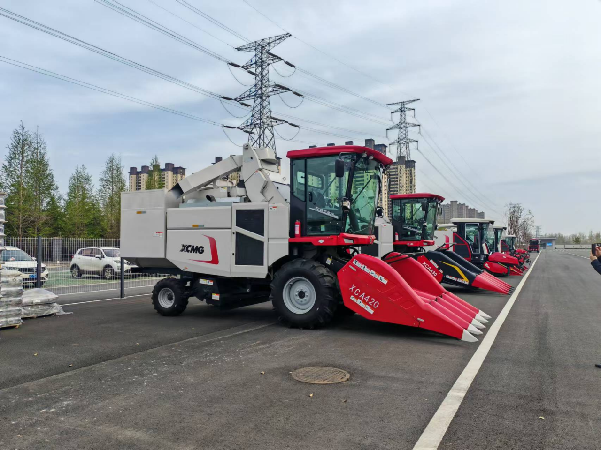
Field Failure Background: XCMG Corn Harvester Program
In early 2024, XCMG Group launched an 800–1,000 unit corn harvester production program targeting large-scale field deployment for the harvest season.
During prototype validation, three critical hydraulic issues repeatedly appeared under real field conditions:
- Hydraulic fluid temperature rising to 78°C under rated load
- Stripper roller speed fluctuation of ±15% during dense crop sections
- Two premature valve body failures within 300 operating hours
Initial adjustments focused on increasing system relief pressure. However, this only worsened thermal behavior without resolving instability.
At this stage, the issue was no longer treated as a tuning problem—it became a system architecture problem.
Why Standard Hydraulic Valves Failed in This Application
The core limitation was not component quality, but response mismatch under dynamic agricultural load conditions.
Load-Sensing Response Lag
Standard load-sensing valves typically respond within:
- 20–80 ms pilot response time
However, in XCMG’s harvester system:
- Pressure rises from ~80 Bar to 160–220 Bar within 8–12 ms
- Load events repeat every 15–40 ms during dense crop engagement
This created a fundamental mismatch:
👉 The valve reacts after the pressure spike has already occurred.
Micro-Relief Cycling Effect
Because of delayed response:
- Relief valve opens repeatedly under normal operation
- Each cycle converts mechanical energy directly into heat
- System experiences 28–35 micro-relief events per minute
This leads to:
- Continuous thermal accumulation
- Accelerated spool wear
- Hydraulic instability under load transitions
Root Cause: System-Level Hydraulic Architecture Mismatch
The failure was not isolated to the valve itself.
The harvester’s mechanical design includes a 35mm vertical offset stripper roller system, designed to improve crop stripping efficiency.
However, this creates:
- Out-of-phase torque pulses across dual drive circuits
- Conflicting pressure signals in a shared load-sensing hydraulic control loop
As a result:
👉 A single load-sensing valve was forced to interpret two unsynchronized pressure sources.
This led to unstable control behavior that could not be corrected through pressure adjustment alone.
Engineering Solution: Non-Linear Hydraulic Valve Design
To resolve the mismatch, Rekith developed a non-linear throttle groove spool architecture specifically tuned for high-frequency agricultural load cycles.
Design Principle
Instead of a linear flow-area relationship, the spool profile was engineered to provide:
- Fast flow increase at initial displacement
- Controlled mid-range flow stabilization
- Linear behavior at full stroke capacity
This enables the valve to begin compensating during pressure rise, rather than after threshold activation.
Precision Manufacturing Specifications
- Spool machining tolerance: ±0.008 mm
- Surface finish: Ra ≤ 0.4 μm
- 100% CMM inspection per production batch
- Cleanliness standard: ISO 4406 18/16/13
How the Design Eliminates Micro-Relief Events
The non-linear spool geometry introduces passive pre-compensation behavior:
- Early-stage pressure rise is partially absorbed internally
- Reduces peak overshoot before relief activation threshold
- Eliminates repeated relief valve cycling under transient load
Resulting system improvements:
- Peak pressure reduced from 140 Bar → 35–50 Bar
- Micro-relief events reduced from 28–35/min → 0–2/min
- System thermal load significantly stabilized
Field Performance Results (Multi-Unit Validation)
Across instrumented prototypes and production units:
| Metric | Standard Valve | Custom Valve | Improvement |
|---|---|---|---|
| Peak fluid temperature | 78°C | 61°C | -22% |
| Roller speed variation | ±14–17% | ±2.5–3.5% | -80% |
| Micro-relief events | 28–35/min | 0–2/min | -94% |
| Maintenance interval | 150–200 hrs | 800+ hrs | 4× longer |
| Hydraulic downtime | 2.3/100 hrs | 0 | Eliminated |
Field operators reported stable performance even under continuous heavy crop density variation.
What This Case Means for OEM Hydraulic System Design
This case demonstrates a critical principle in mobile hydraulics:
👉 Hydraulic valve failure in agricultural machinery is often a system timing mismatch problem, not a component defect.
Key implications for OEM design:
- Load dynamics must be modeled at millisecond scale, not averaged load values
- Load-sensing systems must account for multi-source pressure interference
- Relief cycling is often a symptom of architectural mismatch, not incorrect calibration
When Custom Hydraulic Valves Are Required
Custom hydraulic solutions become necessary when:
- System overheating persists despite correct pump and cooling sizing
- Actuator instability cannot be resolved via pressure adjustment
- Valve lifetime falls significantly below rated specification (200–400 hrs vs 2,000+ hrs)
- Standard catalog substitutions fail to improve system behavior
결론
The XCMG corn harvester case shows that modern agricultural machinery increasingly operates outside the assumptions of standard hydraulic component design.
When load dynamics occur at millisecond resolution, conventional valve architectures become insufficient.
In these conditions, system-specific hydraulic design is required—not component replacement.
Request Engineering Evaluation
Provide your system parameters:
- Operating pressure (Bar)
- Load cycle characteristics
- Failure history (if any)
Engineering analysis is typically returned within 24 hours, focusing on system-level hydraulic architecture rather than catalog matching.Learn more about hydraulic valve failure mechanisms or explore custom solutions for industry applications.