
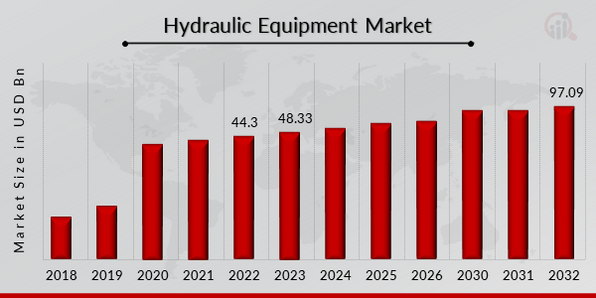
In 2022, the hydraulic equipment market was valued at $44.3 billion. It is projected that the hydraulic equipment market will grow from $48.33 billion in 2023 to $97.09 billion by 2032, with a compound annual growth rate (CAGR) of 9.11% from 2024 to 2032. The primary market drivers are the increasing demand for material handling equipment and the widespread adoption of mechanized agricultural equipment. Additionally, the rise in underwater exploration activities has also propelled the growth of the hydraulic equipment market. Let’s look at some data:
Adoption of Mechanized Agricultural Equipment Drives Market Growth
Agriculture has long been a crucial global industry. In the past, tasks such as planting, plowing, harvesting, applying fertilizers and pesticides, and other processes were done manually. With industrialization and the development of new technologies, modern farmers prefer using machines for agricultural chores. The increasing use of agricultural equipment and the rise in agricultural automation and mechanization have driven the growth of the hydraulic equipment market in recent years.
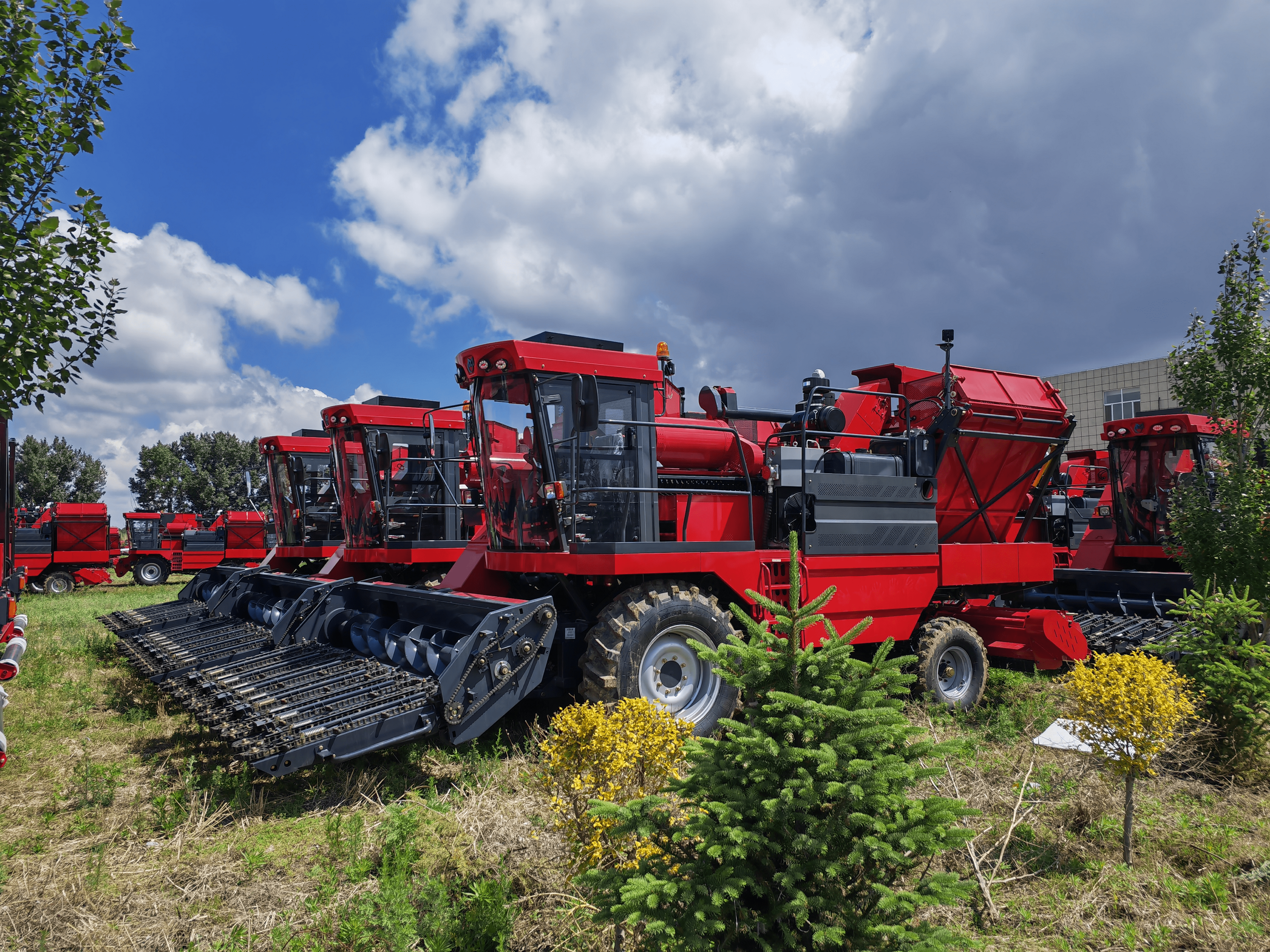
Below is a case study that delves into how a multi-way valve operates in a self-propelled corn harvester
Due to the need for self-propelled corn harvesters to perform various tasks such as walking, steering, lifting the header, and adjusting harvesting components, the multi-way valve, as the core component of the hydraulic system, can conveniently control multiple actuators (such as hydraulic cylinders and hydraulic motors) in the hydraulic system. Additionally, it can control multiple hydraulic circuits through one valve body, simplifying the design and layout of the hydraulic system. The integration of multiple hydraulic control functions in the multi-way valve reduces the number of hydraulic lines and joints, thus lowering the risk of pressure loss and leakage in the hydraulic system, improving system efficiency and reliability.
The multi-way valve, also known as a multi-way directional valve, is a multifunctional composite control valve integrating directional valves, safety overflow valves, check valves, make-up valves, flow divider valves, and brake valves. It is primarily used in hydraulic systems of vehicles, construction machinery, and other mobile machinery to centralize control of multiple actuators. Compared to other hydraulic valves, the multi-way valve features a compact structure, simple piping, low-pressure loss, low sliding valve resistance, and multiple position functions in hydraulic systems.

Product Features:
Maximum working pressure: 15 bar
Maximum working flow: 40 L/min
Threaded connection for working oil ports
Optional auxiliary handle operation
Solenoid-driven
Multiple units selectable
Integrated overflow valve
Therefore, selecting a high-performance, high-reliability multi-way valve is crucial. Land-based hydraulic products focus on both performance and reliability in design and manufacturing, making them widely applicable to high-demand, high-efficiency, and highly complex agricultural machinery.
The addition of the multi-way valve allows the self-propelled corn harvester to more effectively control various hydraulic actuators, ensuring the machine can efficiently and reliably complete various field tasks.
How does the multi-way directional valve cooperate with different hydraulic components and related parts in a self-propelled corn harvester?
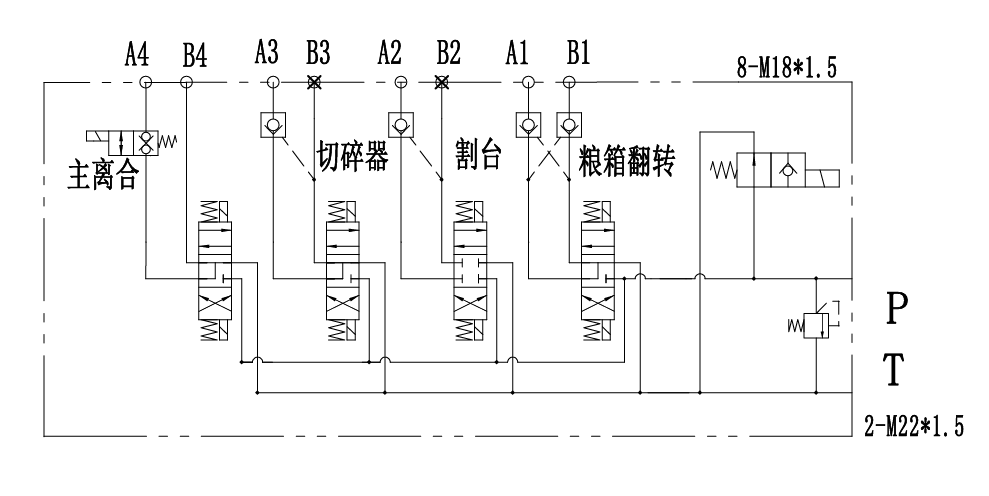

- System Loading and Unloading:
- The inlet solenoid valve is responsible for system loading and unloading.
- The inlet overflow valve is responsible for system pressure.
- Main Clutch Control:
- Main Clutch: Controls the disconnection and connection of the main clutch cylinder. When the main clutch needs to be disconnected, the B-end of the solenoid valve is energized, the main clutch pressure-holding valve is energized, the cylinder retracts, disconnecting the compressed pulley and cutting off the transmission supply. When the main clutch needs to be connected, the A-end of the solenoid valve is energized, the main clutch pressure-holding valve is energized, the cylinder extends, pressing the pulley. The power supply to the fourth piece of the multi-way valve is cut off, maintaining the pulley in a compressed position, and connecting the transmission mechanism.
- Header Lifting:
- Integrated with a unidirectional hydraulic lock function, it is responsible for lifting the corn harvester header and can hold the header in any position without falling. The header’s descent relies on the hydraulic valve reversing to open the load hydraulic lock, allowing the header to slowly drop by its weight. Equipped with an E valve core, it provides temporary cushioning when the heavy header is closed, reducing the jolt caused by power failure.
- Chopper Lifting:
- Integrated with a unidirectional hydraulic lock function, it is responsible for lifting the corn harvester chopper and can hold the chopper in any position without falling. Since the chopper is relatively light, its descent due to gravity is not fast, so it is equipped with a J function valve core.
- Grain Tank Tipping:
- Integrated with a bidirectional hydraulic lock function, it is responsible for the tipping function of the grain tank, allowing the grain tank to remain stable at any tipping angle.
Through this case study, it is clear that the multi-way directional valve in the self-propelled corn harvester integrates various functions (such as unidirectional hydraulic locks and bidirectional hydraulic locks) to achieve precise control of multiple hydraulic actuators, ensuring the machine’s stability and reliability during various operational stages.